
Shockwave Therapy Canary Wharf | ESWT Treatment | Physio 1st UK
Extracorporeal Shockwave Therapy
Shockwave Therapy (ESWT) in Canary Wharf
ESWT is recognised by the National Institute for Health and Care Excellence (NICE), which has issued specific guidance supporting its use for conditions including plantar fasciitis, Achilles tendinopathy, and tennis elbow.
Physio 1st UK provides advanced Shockwave Therapy in Canary Wharf for patients suffering from chronic tendon pain, sports injuries, and soft tissue conditions. Our physiotherapists assess each patient individually to determine whether ESWT is suitable for their condition.
What Is Shock Wave Therapy and How Does It Work?
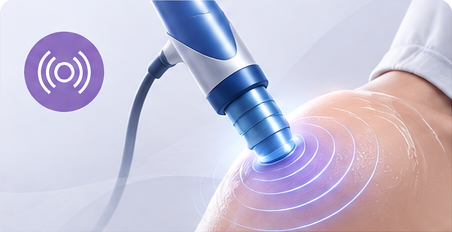
“Extracorporeal” simply means “outside the body” — a handheld device delivers high-energy acoustic pulses through the skin to the injured area, without needles or incisions.
Once delivered, these shockwaves trigger several biological repair processes:
Angiogenesis
New blood vessels form around the injury, improving circulation and oxygen supply to the damaged tissue.
Mechanotransduction
Mechanical energy from the shockwaves is converted into cellular signals that switch on the body’s repair mechanisms.
Controlled Microtrauma
The therapy creates tiny, controlled micro-injuries that prompt the body to treat the area as needing active repair, restarting a healing process that had stalled.
Breakdown of Calcific Deposits
In conditions like calcific tendinopathy of the shoulder, shockwaves help disperse calcium build-up within the tendon.
Pain Gate Modulation
Many patients notice a reduction in pain sensitivity within the first few sessions, thought to be linked to desensitisation of local pain receptors.
Conditions We Treat With ESWT in Canary Wharf
Our physiotherapists at Physio 1st UK Canary Wharf commonly use shockwave therapy for:
Plantar fasciitis
Heel
Achilles tendinopathy
Ankle
Tennis elbow
Elbow
Patellar tendinopathy
Knee
Calcific tendinopathy
Shoulder
Greater trochanteric pain syndrome
Hip
Proximal hamstring tendinopathy
Hip
ESWT is typically recommended once conservative treatments — rest, orthotics, stretching, anti-inflammatory medication, or manual physiotherapy — haven’t fully resolved symptoms after several weeks, which is why it’s often described as a treatment for “refractory” (treatment-resistant) tendon conditions.
What to Expect During a Shockwave Therapy Session
Session Length
Most sessions take 5–15 minutes per treated area.
Course of Treatment
A typical course is 3–6 sessions, usually spaced one to two weeks apart, since the tissue needs time to respond between treatments.
Sensation During Treatment
You may feel a tapping or mild discomfort during treatment, and some soreness for a day or two afterwards — this is a normal part of the healing response, not a sign of harm.
No Anaesthesia Required
ESWT is typically performed without local anaesthetic, as several studies suggest this doesn’t affect the treatment’s effectiveness.
Immediate vs. Cumulative Effect
Some patients feel pain relief after the first session, but the full benefit builds cumulatively across the whole course — it’s important to complete the recommended sessions even if early improvement feels good.
Benefits of Shockwave Therapy
Pain Relief
By stimulating nerve desensitisation and reducing inflammation, ESWT can meaningfully reduce chronic pain from tendinopathies and heel conditions.
Accelerated Tissue Healing
The angiogenesis and cell signalling triggered by treatment support faster, more complete repair of damaged tendons and soft tissue.
Breaks Down Calcific Deposits
For calcific tendinopathy, ESWT can help disperse the calcium build-up that causes ongoing irritation and restricted movement.
Non-Invasive Alternative
Because it avoids surgery, injections, and medication, ESWT carries a lower risk profile and typically requires no recovery downtime.
Safety and Contraindications of ESWT
ESWT is generally safe when delivered by a trained physiotherapist, but it isn’t suitable for everyone.
You should tell your physiotherapist before treatment if you:
Your physiotherapist at our Canary Wharf clinic will carry out a full assessment before your first session to confirm ESWT is appropriate for your condition.
Why Choose Physio 1st UK for Shockwave Therapy in Canary Wharf?
Our physiotherapists assess each patient individually before recommending ESWT, ensuring it’s used where the evidence — and NICE guidance — supports it, and combined where appropriate with a broader rehabilitation plan (strengthening, stretching, and load management) rather than used as a standalone quick fix.
Book a Shock Wave Therapy assessment with one of our physiotherapists today.